

Last technically reviewed: 11 September 2026. Updated for Commissioner of Taxation v Bendel [2026] HCA 18, the refusal of special leave in S.N.A Group, and Treasury's 3 September 2026 exposure draft on a minimum tax for discretionary trusts. An update log is at the end of the article.
A medical service trust supplies premises, staff, equipment and administration to a practitioner for a fee. The fee must be priced for real services and supported by a current agreement. Four separate questions decide the tax outcome: is the fee deductible, is the doctor's income PSI, are trust distributions valid, and do GST and payroll tax apply. This guide works through each, with a full worked example and the 2026 changes.
If you own or are about to set up a medical practice, this guide is for you. It is written for GPs, specialists and practice owners who need to decide three things: whether a service entity suits the practice, how to price the fee it charges, and how to run the arrangement so that the deduction, the trust distributions and the GST treatment all hold up.
The structure is lawful and common. The difficulty is that three different tax issues get blended into one conversation: whether the service fee is deductible, how profits of a genuine service business are taxed, and whether a doctor's personal earnings are being diverted. Each has its own rules. We keep them apart below, in the order a practice actually meets them.
How Does a Medical Service Trust Work, and Who Contracts With Whom?
A service trust is a trust whose trustee supplies non-clinical services (premises, staff, equipment, IT, administration) to a medical practitioner for a fee. The trustee signs the lease, employs the staff and issues the invoices. The practitioner or practice entity pays the fee, claims a deduction where the fee is incurred in earning income, and keeps the clinical revenue.
A service entity can be a company or a trust. The distinction matters for who signs what. A company contracts in its own name: that is a service company. A trust has no legal personality of its own, so the trustee (usually a corporate trustee) enters the contracts, holds the lease and equipment, and employs the staff, in its capacity as trustee. A trust is treated as an entity for income tax purposes under section 960-100 of the ITAA 1997, but that is a tax fiction, not separate legal existence.
In practice this means the service agreement should be between the practitioner (or the practice company) and the trustee of the service trust. The payroll, the premises lease and the equipment finance should sit with the same trustee. When the agreement names the trust but the lease is in a director's name and the staff are paid by the practitioner, the arrangement has already lost the substance it depends on.
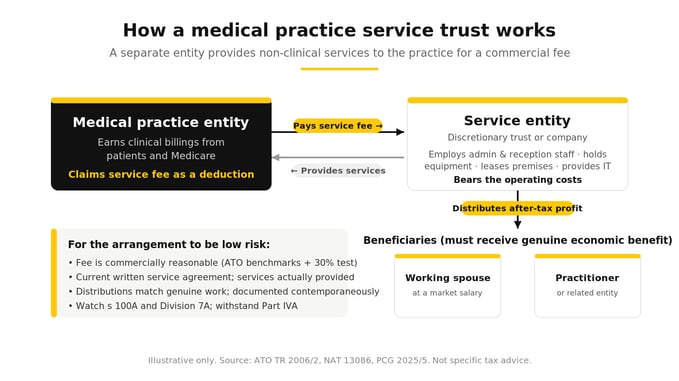
The arrangement traces back to Federal Commissioner of Taxation v Phillips [1978] FCA 28; (1978) 36 FLR 399, where the Full Federal Court accepted service fees paid by an accounting firm to a related trust as deductible. The ATO's position on these "Phillips arrangements" is set out in Taxation Ruling TR 2006/2 and its companion guide, Your service entity arrangements. Both remain current. We work through the mechanics with medical and dental practice clients as part of structuring and annual review work.
Why Do Medical Practices Use a Service Entity?
Medical practices use a service entity to hold the lease, staff and equipment in one place, so that several practitioners can share costs, doctors can join or leave without unwinding the premises, and the business side of the practice can be sold or passed on separately from any individual's clinical work. Tax outcomes follow from that commercial substance, not the other way round.
The commercial case is strongest in a group practice. One entity employs the receptionists and practice nurses, holds the lease and the equipment finance, runs the practice software and bills each practitioner for the package. A new associate signs one agreement rather than inheriting a share of every contract. When a partner retires, the business infrastructure stays put.
Asset protection is often cited and needs qualification. Separating the premises and equipment from the practitioner's clinical liability can help, but only to the extent the assets are actually owned by the service entity, the practitioner has not personally guaranteed the lease or finance, and the trustee is not itself exposed through its own employment and tenancy obligations. Professional indemnity remains the practitioner's. A service entity does not remove liability; at best it fences some assets off from it.
Where the service entity is a discretionary trust, its genuine service-business profit is distributed to beneficiaries under the deed. That is a legitimate consequence of running a real business through a trust. It is a problem only when the "profit" is really the doctor's own clinical earnings routed through a fee that exceeds the value of what was supplied. The rest of this guide is about keeping those two things separate. Our tax planning work for practices starts with that line.
How Should Medical Service Fees Be Priced?
Service fees are priced either as a percentage of the practitioner's gross fees or as the service entity's costs plus a mark-up. For a GP practice where the service entity runs the whole practice, the ATO's guide treats fees up to 40% of gross practice fees (45% for rural or sole practitioners) as low audit risk. Those figures are conditional administrative indicators, not approved prices, and they do not apply to specialists.
The two pricing methods are different and should not be blended. Under percentage pricing, the fee is a set share of the practitioner's billings; it rises and falls with clinical revenue and the service entity carries the cost risk. Under cost-plus pricing, the fee is the service entity's actual costs (wages, rent, consumables, software, depreciation) plus a margin that a third-party provider would expect. TR 2006/2 accepts either, provided the result is a commercial rate for the services actually supplied.
The 40% and 45% figures come from the ATO's service entity guide, not from TR 2006/2 itself. They describe one model: a general practice where the service entity provides the complete package of premises, staff, equipment, administration and practice management for a percentage of gross practice fees. Change the facts and the benchmark stops being informative.
Four things the fee schedule should state
- What the fee includes. List the services: rooms, reception and nursing staff, equipment, consumables, IT and software, bookkeeping, billing and debt collection, marketing. A 35% fee for rooms alone is a very different proposition from a 35% fee for the whole practice.
- Whether the percentage is GST-inclusive or exclusive. The service entity's supply is taxable (see the GST section below). State the fee as GST-exclusive and add GST on the invoice, or make the inclusive basis explicit.
- The billings base. Gross fees billed, fees received, or fees net of bulk-billing incentives and Practice Incentive Program payments. Define it and apply it consistently.
- The pricing method. Percentage or cost-plus, and if cost-plus, the mark-up and the cost categories it applies to.
Reading the fee percentage
| Fee as % of gross GP fees | Where the ATO guide places it | What still has to be true |
|---|---|---|
| Up to 40% | Low audit risk for a comprehensive GP practice-management model | The service entity really does run the practice. A 38% fee for rooms and a part-time receptionist is not low risk. |
| Up to 45% | Low audit risk for rural practices and sole practitioners on the same model | The rural or sole-practitioner facts apply and the higher cost base is evident in the accounts. |
| Above the indicator | Not automatically excessive; the ATO may ask for the commercial explanation | Comparable market evidence or a cost-plus build-up that supports the figure. |
| Specialists (any %) | The GP benchmarks do not apply | Independent comparable prices or comparable profits evidence for the services actually supplied. |
Source: ATO, Your service entity arrangements (NAT 13086), read with TR 2006/2. Percentages are indicators of audit risk, not safe harbours and not a test of deductibility.
Deductibility itself turns on section 8-1 of the ITAA 1997 as explained in TR 2006/2: was the fee incurred in gaining assessable income, and is there an objective commercial explanation for the whole of it? A fee below 40% can fail that test where little was supplied. A fee above it can pass where the service entity carries a full cost base. The percentage is a screening tool; the accounts and the agreement are the evidence. Our bookkeeping team sets up service-entity ledgers so that the cost base behind the fee is visible line by line.
What Is the 30% Combined Profit Indicator, and How Is It Calculated?
The ATO's service entity guide treats an arrangement as low audit risk where the service entity earns no more than 30% of the combined profits of the practice and the service entity. The measure uses profit from the accounts, not taxable income, and cannot be worked out from billings and the fee alone. It is an administrative indicator, not a statutory test of deductibility.
The fee percentage and the profit share answer different questions. The fee percentage asks how much of the doctor's gross revenue leaves the practice. The profit share asks how much of the total profit generated by doctor and service entity together ends up in the service entity. A high fee attached to a high cost base can produce a modest profit share. A moderate fee attached to almost no costs produces a very high one. The ATO guide explains the adjustments it expects in the profit calculation, including the treatment of owners' remuneration, so use it rather than the raw statutory accounts.
Worked example: one GP, two fee levels, the same combined profit
A metropolitan GP bills $800,000 a year. Her service trust employs the reception and nursing staff, holds the lease, owns the equipment and runs the software. Its own operating costs are $220,000. The GP has $20,000 of expenses the trust does not cover (registration, indemnity, CPD). Two fee levels are compared.
| Item | Scenario A | Scenario B |
|---|---|---|
| Practitioner billings | $800,000 | $800,000 |
| Service fee | $296,000 | $380,000 |
| Service fee as % of billings | 37.0% | 47.5% |
| Service-entity expenses (assumed) | $220,000 | $220,000 |
| Service-entity profit | $76,000 | $160,000 |
| Other practitioner expenses (assumed) | $20,000 | $20,000 |
| Practitioner profit after expenses | $484,000 | $400,000 |
| Combined profit | $560,000 | $560,000 |
| Service entity's share of combined profit | 13.6% | 28.6% |
Illustrative arithmetic only. All figures exclude GST. Profit shares: $76,000 / $560,000 and $160,000 / $560,000.
Three things follow. First, the two percentages measure different things: Scenario B's 47.5% fee sits above the GP indicator, yet its profit share of 28.6% sits below 30%. Second, neither scenario proves the fee is deductible. That depends on what the $220,000 actually bought, whether a third party would charge $296,000 or $380,000 for it, and whether the agreement and invoices support the liability. Third, the fee in Scenario B leaves the service trust with $160,000 to distribute. Whether that is a genuine service-business profit or the GP's own earnings in another wrapper is the question the next two sections address.
Is the Doctor's Income PSI, and What Does PCG 2025/5 Change?
Patient fees earned mainly from a doctor's own skill and effort are personal services income (PSI) under Division 84 of the ITAA 1997, whoever bills them. PCG 2025/5, issued by the ATO on 28 November 2025, sets out when Part IVA may apply where PSI is derived through an entity that passes the personal services business tests and the profit is split or retained. It does not govern the service entity's own fee income.
This is where medical structures most often go wrong in analysis. The service trust's fee income is not the doctor's PSI; it is consideration for premises and services. The doctor's patient fees may well be PSI. Treating the two as one pool, then asking whether "the structure" passes a PSB test, produces the wrong answer. Work through the questions in this order.
- Who legally derives the patient fees? The doctor personally, a practice company, or a practice trust. Check the Medicare provider arrangements, the patient invoices and the bank account.
- Is that income PSI? Under TR 2022/3, income is PSI where it is mainly a reward for an individual's personal efforts or skills. For most consulting doctors, it is.
- If so, do the PSI attribution rules apply, or is the entity conducting a personal services business? The results test in section 87-18 can be self-assessed. The unrelated clients, employment and business premises tests can only be self-assessed where less than 80% of the PSI comes from one source and its associates (section 87-15); otherwise a personal services business determination from the ATO is needed. A doctor contracting to a single medical centre frequently hits that 80% limit.
- What separate services does the service entity supply? List them and match them to the agreement, the payroll and the lease.
- Are its fees, and the profit they produce, commercially supportable? That is the TR 2006/2 question from the previous two sections.
PCG 2025/5 is directed at step 3. It concerns PSI derived through a personal services entity that conducts a personal services business, and the circumstances in which the ATO will apply compliance resources to consider Part IVA where that income is split with associates or retained in the entity. Passing a PSB test switches off attribution under Division 86; it does not convert PSI into income generated by a business structure, and it does not answer the Part IVA question. Where a service entity has substantial income-producing assets or a number of employees, so that its income is business-structure income, the ATO's separate PCG 2021/4 on professional firm profits may be the relevant framework, subject to its own scope and gateways. The ATO expressly distinguishes the two guidelines. Not every medical service entity falls within PCG 2021/4, and neither guideline is a general service-trust compliance code.
On timing, the ATO states in PCG 2025/5 that it will not apply compliance resources to pursue Part IVA where a taxpayer has made a genuine attempt to move into a low-risk arrangement by 30 June 2027, and it describes reviews that commence during the transition period. That is a conditional compliance stance, not an amnesty, and it does not suspend the law for arrangements that remain in place. For the tests themselves, see our PSI basics for doctors, and for arrangements that reach beyond PSI into firm-profit allocation, our professional services accounting page.
Do Service Trust Distributions Have to Match Work Performed?
No. There is no general rule that a beneficiary must work in the service business to receive a distribution of its genuine profit. Entitlements depend on the trust deed, a valid trustee resolution, and the trust taxation and anti-avoidance provisions, chiefly section 100A and Part IVA. Work performed is the relevant question for a salary, not for a distribution.
Earlier versions of this guide implied that distributions should be proportionate to services rendered by family members. That conflates four different payments, each of which is tested differently.
| Payment | The relevant question |
|---|---|
| Salary paid to a spouse by the service entity | Was the work performed, and is the pay commercially supportable for that role? |
| Service fee paid by the practitioner | Were services supplied under a real obligation, and is the deduction supportable under section 8-1 and TR 2006/2? |
| Distribution of genuine service-business profit | Is the entitlement valid under the deed and resolution, and do section 100A or other trust provisions apply? |
| Allocation of the doctor's own PSI to others | Do the PSI attribution rules apply, and if not, does Part IVA (read with PCG 2025/5)? |
Two examples show why the shortcut misleads. A GP's spouse manages the practice full time and is paid a market salary by the service trust; the trust then distributes its remaining profit to the spouse as well. The salary is tested on work performed. The distribution is tested on the deed, the resolution and section 100A. If the fee that generated the profit was excessive, the spouse's employment does not cure it. Conversely, a service trust with a genuine $76,000 profit (Scenario A above) distributes $20,000 to an adult child at university who does no work in the practice. Nothing in the trust taxation rules requires that child to have worked. The distribution is assessable to the child, and the questions are whether the child is entitled to and actually enjoys the money, and whether the arrangement is an ordinary family dealing. Working spouse does not mean low risk; non-working adult beneficiary does not mean unacceptable.
Section 100A: four elements, not one bank transfer
Section 100A of the ITAA 1936 can deem the trustee assessable at the top marginal rate on a beneficiary's entitlement where four elements are present: the entitlement arises out of or in connection with a reimbursement agreement; the agreement provides for a benefit to someone other than the beneficiary; a party had a purpose of reducing someone's tax; and the agreement was not entered into in the course of ordinary family or commercial dealing. The ATO's view is in TR 2022/4, with its compliance approach and risk zones in PCG 2022/2.
Paying the distribution into the beneficiary's bank account is helpful evidence, but it does not settle the matter if the money is then routed back to the practitioner by arrangement. Equally, an unpaid entitlement is not of itself a reimbursement agreement. The review should look at the actual arrangement: what was resolved, who was entitled, where the funds went, who benefited, and what the parties understood at the time. We cover the distribution mechanics and the pending reforms in more depth in share classes vs discretionary trust.
Division 7A after Bendel: what still bites
Many service trusts distribute part of their profit to a corporate beneficiary taxed at the company rate, and leave the entitlement unpaid. On 10 June 2026 the High Court in Commissioner of Taxation v Bendel [2026] HCA 18 dismissed the Commissioner's appeal, holding that the unpaid present entitlement in that case was not, merely because it remained unpaid, a loan under section 109D(3) of the ITAA 1936. The ATO's decision impact statement of 26 June 2026 accepts the outcome and confirms TD 2022/11 will be withdrawn. Simply retaining profit in the trust, or leaving a corporate beneficiary's entitlement unpaid, does not of itself trigger Division 7A.
Three situations remain live and should be distinguished in every review. A UPE standing alone: outside section 109D on the Bendel reasoning, though section 100A and the proposed reforms below still need to be considered. An actual loan or other transaction: where the trust and company have converted the entitlement into a loan, or the company has advanced funds to a shareholder or associate, Division 7A applies in the ordinary way. Trustee payments or loans under Subdivision EA: where a private company has a UPE from the trust and the trustee pays, lends to or forgives a debt of a shareholder or associate of that company, sections 109XA to 109XC can deem a dividend. Treasury stated on 3 September 2026 that legislation on unpaid present entitlements will be progressed separately from the minimum-tax draft, so this is enacted law, judicial interpretation and proposal, and the three should not be blended.
Does a Medical Service Trust Charge GST, and What About Payroll Tax?
Yes. Premises, staff and administrative services supplied by a service entity to a doctor are taxable supplies under section 9-5 of the GST Act, even though the doctor's own medical services are GST-free under section 38-7. The service entity must register once its turnover reaches $75,000 and charge GST on the fee. Payroll tax is a separate state question and the service entity does not resolve it.
GST-free treatment attaches to the medical service supplied to the patient, not to everything that supports it. The ATO's health industry GST issues register confirms that a practitioner who supplies rooms, administrative services and facilities to another practitioner is liable for GST on that supply where section 9-5 is met. The same applies to a service trust. The doctor can claim an input tax credit under section 11-5 only where the doctor is registered and acquires the services for a creditable purpose. Acquisitions that relate to GST-free supplies still meet that test (only input-taxed supplies deny it), so the credit is generally available, but registration is the precondition. See the ATO's summary of GST and medical services.
In practice, this is where structure and bookkeeping meet. For our client Family First Medical Center, the entity that holds the premises supplies rooms and support to the practitioners and allied health providers who work from the centre, and each of those arrangements is invoiced on a regular cycle with GST applied. That discipline, one supplier, a written basis for each fee, and invoices that match it, is what makes the arrangement legible to the ATO and to the practitioners themselves. Our BAS and IAS lodgement service runs the GST side for service entities of this kind.
Victorian payroll tax
A service entity does not take a medical centre outside payroll tax. Payments to contractor doctors can be caught as wages under the relevant contract provisions in section 32 of the Payroll Tax Act 2007 (Vic), and the 2023 Victorian rulings on medical centres remain the reference point. From 1 July 2025, the State Revenue Office exempts wages paid to employee and contractor general practitioners to the extent they relate to fully-funded consultations, a defined term that covers bulk-billed and similarly funded services. The exempt portion is calculated under the statutory apportionment method in Schedule 2 of the Act, not by estimate. The exemption is confined to general practitioners; wages of specialists, dentists and allied health providers are not covered. Our separate guide to payroll tax for medical practices in Victoria works through the rates, thresholds and a full example.
2026 Decisions and Proposed Reforms Affecting Service Trusts
S.N.A Group: the fee must rest on a real obligation
In Commissioner of Taxation v S.N.A Group Pty Ltd [2026] FCAFC 10 (17 February 2026), the Full Federal Court allowed the Commissioner's appeal and denied service-fee deductions. The published catchwords record that there was no objective manifestation of mutual assent to contract on particular terms between the taxpayers and the related party, and no conduct consistent with a liability to pay the claimed fees. The written agreements had expired; the fees continued on the strength of accounting entries and assumed terms. The High Court refused special leave on 11 June 2026. A refusal of special leave is not an endorsement of every step of the Full Court's reasoning; it means the decision stands.
The practical lesson is narrower than "you must have a current signed agreement or the deduction fails". The legal question is whether an obligation to pay existed and the outgoing was incurred. A signed agreement and documented renewals are strong evidence of that and reduce the argument to one about price. Accounting entries do not on their own establish the obligation they record. And better documentation prepared later cannot create facts that did not exist at the time. Diarise agreement expiry dates and renew before, not after.
Bendel: unpaid entitlements are not loans
Covered in the distributions section above. The short version: the High Court's 10 June 2026 decision removes the ATO's position that a UPE owed to a corporate beneficiary is a Division 7A loan, while actual loans, Subdivision EA and section 100A remain fully in play.
Update, 11 September 2026: proposed minimum tax on discretionary trusts. On 3 September 2026 Treasury released exposure draft legislation for a 30% minimum tax on certain discretionary trusts, proposed to commence on 1 July 2028. Consultation closes on 18 September 2026. The draft includes an election under which a trust that commits to fixed distributions to pre-nominated beneficiaries is outside the minimum tax, and proposed roll-over relief for restructures. The Treasurer's release confirms separate legislation on unpaid present entitlements will follow.
These are proposals, not operative law. They may affect how a discretionary service trust distributes from 2028, and existing arrangements should be modelled against the legislation once it is enacted. A draft is not a reason to restructure now, and we have deliberately not built projected savings into this article. The ATO's new legislation page tracks the measure's status.
Service Trust Review Checklist
We recommend a full review every two to three years, with an annual check of the fee calculation and agreement expiry dates, and an immediate review on any material change: a new practitioner, a change of premises, a change in billing levels or mix, a beneficiary reaching adulthood or leaving the practice, or a change in the law of the kind described above. That interval is our recommendation, not an ATO requirement.
- Parties. Is the agreement between the practitioner (or practice entity) and the trustee of the service trust, and do the lease, payroll and equipment finance sit with that same trustee?
- Agreement. Is it current and signed, with renewals documented, and does it define the services, the pricing method, the billings base and the GST basis?
- Fee support. Can the fee be supported by the service entity's cost base or by comparable market evidence, and has the combined profit share been calculated from the accounts?
- Substance. Do the service entity's payroll records, lease, supplier invoices and financial statements show it actually delivering the services?
- Character of income. Has the doctor's income been assessed under Division 84 first, then the PSB tests and the 80% rule, with a determination sought where needed?
- Distributions. Are entitlements valid under the deed and resolved on time, do beneficiaries actually enjoy the funds, and has section 100A been considered against the actual arrangement?
- Corporate beneficiaries. Have UPEs, actual loans and Subdivision EA transactions been separately identified and treated?
- GST and payroll tax. Is the service entity registered and charging GST, and has the payroll tax position of contractor doctors been assessed under the relevant contract rules?
Not sure where your arrangement sits?
Send us the service agreement and the last two years of accounts for the practice and the service entity. We will tell you which of the eight checklist items need attention.
Contact UsWhat a 42 Advisory Service Trust Review Covers
Our review is a defined piece of work with a written outcome. We map the entity relationships and confirm who contracts with whom. We read the service agreement and renewals against what the accounts show was actually supplied. We test the fee methodology, recalculate the fee percentage and the combined profit share from the accounts, and identify what evidence supports the price. We trace distributions for the last two years through the resolutions, the deed and the bank records, and flag section 100A, Division 7A and Subdivision EA exposures. We check the GST registration and invoicing of the service entity and the payroll tax position of contractor practitioners.
You receive a findings report that sets out each issue, its exposure, and a prioritised action list: what to fix before 30 June, what to document, and what to model once the trust reforms are enacted. Where the arrangement is sound, the report says so, and becomes the contemporaneous record for the next review. This sits alongside our small business accounting and business advisory work for practices, and for owners considering a purchase, our guide to buying a dental practice covers the structuring decisions at acquisition.
Key Takeaways
| Issue | Position as at 11 September 2026 |
|---|---|
| Who contracts | The trustee of the service trust signs the agreement, lease and payroll. A company in its own right is a service company. |
| Fee pricing | Percentage or cost-plus. ATO guide: up to 40% (45% rural or sole) of gross GP fees is low audit risk for the full practice-management model only. Specialists need comparable evidence. |
| 30% profit share | Calculated from accounting profit of both entities. A 47.5% fee produced a 28.6% share in our example. Indicator, not a deductibility test. |
| PSI and PCG 2025/5 | Classify the doctor's income under Division 84 first. PCG 2025/5 concerns PSI through a PSB entity and Part IVA; conditional compliance approach for genuine moves to low risk by 30 June 2027. |
| Distributions | No requirement that beneficiaries work in the business. Test the deed, the resolution and section 100A's four elements. |
| Division 7A | Bendel [2026] HCA 18: a UPE is not a loan merely because unpaid. Actual loans and Subdivision EA still apply. UPE legislation to follow separately. |
| GST and payroll tax | Service entity supplies are taxable; register and charge GST. Victorian GP exemption from 1 July 2025 is apportioned and GP-only. |
| Proposed trust minimum tax | Exposure draft 3 September 2026; 30% from 1 July 2028 proposed; consultation to 18 September 2026. Model, do not restructure yet. |
Book a service trust review
A 30-minute online meeting with a CPA to scope the review of your practice and service entity, and agree the written outcome you will receive.
Book a MeetingDisclaimer: The information provided in this article is general in nature and does not constitute specific tax, legal, or financial advice. Service trust arrangements are fact-specific, and the trust reforms discussed are exposure draft proposals that may change before enactment. We recommend seeking professional advice tailored to your individual circumstances before making any structural decisions. 42 Advisory is a CPA firm and Registered Tax Agent.
Update log
11 September 2026: article restructured. Corrected the trust and trustee explanation, the distribution examples, the PSI and PCG 2025/5 analysis and the PSI FAQ. Rebuilt the fee-pricing and combined-profit sections with a full worked example. Updated Division 7A for Bendel [2026] HCA 18 and section 100A for TR 2022/4. Added GST, the Victorian payroll tax detail, the S.N.A Group special leave outcome and the 3 September 2026 exposure draft. Removed income statistics and the tax-rate chart.
Frequently Asked Questions
What is the difference between a service trust and a service company?
Both are service entities. A service company contracts, employs and holds assets in its own name. A service trust acts through its trustee, which signs the service agreement, lease and employment contracts in its capacity as trustee. A trust is an entity for income tax purposes but has no separate legal personality, so the trustee is the party on every document.
Can a GP contractor use a service trust if they pass the PSB tests?
Passing a personal services business test switches off PSI attribution under Division 86, but only the results test can be self-assessed regardless of client concentration. Where 80% or more of the PSI comes from one source and its associates, the unrelated clients, employment and business premises tests cannot be self-assessed and a personal services business determination is required. Even with PSB status, PCG 2025/5 confirms Part IVA can apply to the splitting or retention of that PSI.
Is a service fee of 40% of billings automatically deductible?
No. The 40% figure is an audit-risk indicator in the ATO's service entity guide for a comprehensive GP practice-management model. Deductibility depends on section 8-1: whether the fee was incurred under a real obligation for services actually supplied, at a commercially explicable price. A lower fee for few services can fail; a higher fee with a full cost base can pass.
Does leaving a corporate beneficiary's entitlement unpaid trigger Division 7A?
Not on its own. In Commissioner of Taxation v Bendel [2026] HCA 18 (10 June 2026) the High Court held that the unpaid present entitlement in question was not a loan under section 109D(3) merely because it remained unpaid. Division 7A still applies to actual loans and to Subdivision EA transactions, and section 100A must be considered separately. The Government has said UPE legislation will be progressed separately.
Does a service trust have to charge GST to the doctor?
Yes, once registered or required to register. The supply of premises, staff and administration to a practitioner is a taxable supply under section 9-5 of the GST Act. It does not become GST-free because it supports GST-free medical services. The doctor, if registered, generally claims the input tax credit under section 11-5.
Will the proposed 30% minimum tax on trusts apply to my service trust?
It is not law. Treasury released exposure draft legislation on 3 September 2026 for a 30% minimum tax on certain discretionary trusts from 1 July 2028, with an election for trusts that commit to fixed distributions to pre-nominated beneficiaries. Consultation closes 18 September 2026. Existing service trusts should model the enacted legislation when it passes rather than restructure on a draft.
How often should a medical service trust be reviewed?
We recommend a full review every two to three years, an annual check of the fee calculation and agreement expiry dates, and an immediate review on a material change such as a new practitioner, new premises, a change in billing mix, or a change in the law. This is our recommendation as a firm; the ATO does not prescribe a review interval.