

2025-26 (the return you are lodging now): eligible small businesses with aggregated turnover under $10 million can immediately deduct the full GST-exclusive cost of each eligible asset costing less than $20,000, provided it was first used or installed ready for use by 30 June 2026. This is settled law.
From 1 July 2026: the $20,000 threshold is set to continue permanently. The Treasury Laws Amendment (Tax Reform No. 2) Bill 2026 passed the Senate on 19 August 2026 and awaits Royal Assent. Until assent is given we recommend treating the permanent threshold as near-certain rather than final.
Last updated: 26 August 2026. We maintain this page as the legislative position changes.
Key Takeaways
| Key Point | Details |
|---|---|
| Threshold | $20,000 GST-exclusive, per asset. The limit applies to each asset separately, not to your total spend. |
| Who can claim | Sole traders, partnerships, companies and trusts carrying on a business with aggregated annual turnover under $10 million. |
| 2025-26 claims | Asset first used or installed ready for use by 30 June 2026. Settled law. Claim it in the return being prepared now. |
| From 1 July 2026 | $20,000 threshold set to become permanent. Bill passed the Senate 19 August 2026; Royal Assent pending. The annual extend-or-expire cycle ends. |
| Eligible assets | New or second-hand depreciating assets used in the business: tools, utes, trailers, site equipment, laptops, safety gear. Building improvements do not qualify. |
| Assets $20,000 or more | Not eligible. Small businesses using simplified depreciation pool them at 15% in year one and 30% thereafter. |
| Vehicles | Use GST-exclusive cost and business-use percentage. Car cost limit $69,674 for 2025-26. Most one-tonne-plus utes are not "cars" and are not capped. |
| Record-keeping | Keep tax invoices, proof of first use and business-use records for five years. Digital records are accepted. |
Introduction
Australia's construction and trades sector remains busy, but the tax rules catch many tradies off guard. The instant asset write-off is one of the most valuable concessions available to small building businesses, yet many operators are still unsure how it works or what has changed.
In our experience advising Melbourne tradies and builders, a structured approach to asset purchases can mean several thousand dollars in additional tax savings within a single financial year, simply by getting the eligibility, timing and documentation right.
For more than a decade the threshold was set on a temporary, year-by-year basis, often legislated only weeks before the previous extension expired. That cycle is ending. The 2026-27 Federal Budget announced a permanent $20,000 threshold, and the enabling Bill passed the Senate on 19 August 2026. For tradies, this removes the annual cliff that drove so much June rush-buying, and shifts the planning question from "will it still be there next year" to "when does this purchase actually make commercial sense".
This guide explains the $20,000 threshold as it applies to 2025-26 claims and from 1 July 2026, which assets qualify, how to calculate the benefit for a ute, and the records the ATO expects. Our builders and tradies accounting team in Melbourne can help you implement an asset purchase strategy aligned with your business plans.
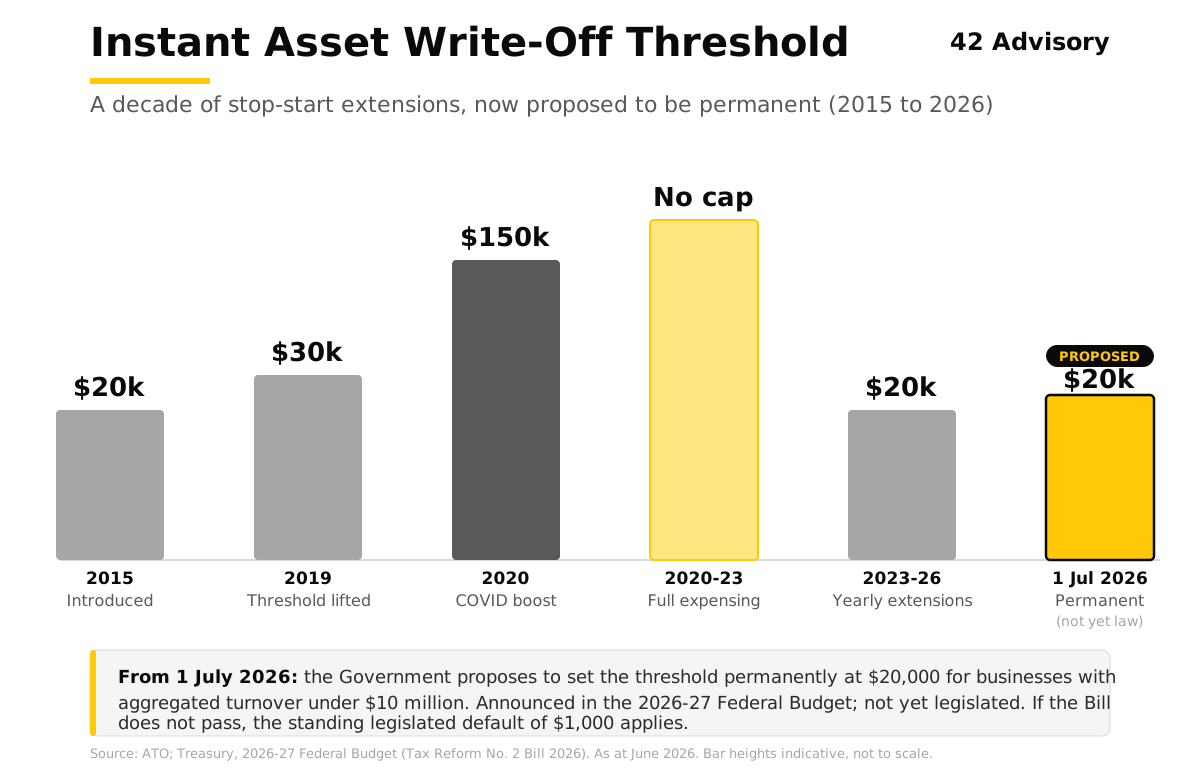
Source: ATO; Treasury, 2026-27 Federal Budget. Updated 26 August 2026.
What Is the Instant Asset Write-Off Threshold?
The threshold is $20,000 per asset, GST-exclusive, for businesses with aggregated annual turnover under $10 million. It applied to assets first used or installed ready for use by 30 June 2026 for 2025-26 claims, and continues from 1 July 2026 under the Bill that passed the Senate on 19 August 2026. The limit applies to each asset separately, not to your total purchases.
The instant asset write-off lets eligible small businesses claim a full deduction for an asset in the year it is acquired and used in the business, rather than depreciating it over several years. This is a significant cash-flow advantage, particularly for tradies investing in equipment.
Eligibility Criteria
To qualify, your business must meet all of these conditions: you are a small business entity (aggregated annual turnover under $10 million), the asset costs less than $20,000 (GST-exclusive if you are registered for GST), and the asset is first used or installed ready for use in the income year you are claiming.
If your turnover exceeds $10 million, you lose access to this concession and revert to standard depreciation. The asset must also be a depreciating asset used in the business. The key date is when you first use the asset, not when you pay for it. An asset bought in June 2026 but not put to work until July falls into 2026-27, not 2025-26.
GST and the $20,000 Threshold
The $20,000 limit uses the GST-exclusive cost of the asset. If you are registered for GST and buy an asset for $21,450 including GST, the GST-exclusive cost is $19,500, which is under $20,000 and qualifies. Note that an asset costing exactly $20,000 GST-exclusive does not qualify, because the test is "less than $20,000". If you are not registered for GST, the full purchase price is used. GST itself is claimed separately as an input tax credit on your BAS.
For full details on eligibility, see the ATO's instant asset write-off page.
Is the $20,000 Instant Asset Write-Off Permanent?
It is set to be. The 2026-27 Federal Budget (12 May 2026) announced a permanent $20,000 threshold from 1 July 2026 for businesses with aggregated turnover under $10 million. The Treasury Laws Amendment (Tax Reform No. 2) Bill 2026 passed the Senate on 19 August 2026 and awaits Royal Assent. Once assent is given, the annual extend-or-expire cycle ends.
This matters more to tradies than the headline number suggests. Under the old arrangement the threshold reverted to $1,000 each year unless Parliament acted, and it often acted late. That created genuine uncertainty for anyone planning a significant equipment purchase across a June boundary, and it drove a great deal of spending that was tax-motivated rather than commercially sound.
A permanent threshold changes the planning conversation. The question becomes whether you need the asset and whether the cash flow works, not whether the concession will survive another Budget. It also means a purchase deferred from June to July no longer forfeits the deduction entirely; it simply lands in the following income year.
One caveat on currency. At the time of writing the ATO had not updated its new legislation page for the Senate vote, and that page still described the measure as not yet law. ATO guidance pages typically lag Royal Assent by several weeks. We are monitoring the position and will update this page when assent is confirmed.
2026-27 Federal Budget: other measures relevant to tradies
- $20,000 instant asset write-off made permanent from 1 July 2026 for businesses with aggregated turnover under $10 million. Passed the Senate 19 August 2026; Royal Assent pending.
- Loss carry-back for eligible companies, allowing a refund to be claimed against tax paid in the prior two income years. Included in the same Bill. Relevant if you trade through a company.
- Simplified depreciation re-entry. The five-year lock-out rule remains suspended to 30 June 2027, so a business that previously opted out of the simplified rules can re-enter and access the write-off.
- Monthly PAYG instalments proposed as an opt-in from 1 July 2027, to better match instalments to cash flow. Announced, not yet law.
- $1,000 instant work-related deduction proposed from 2026-27 for employees, claimable without receipts. Relevant to any wages you draw as an employee of your own company. Announced, not yet law.
Status as at 26 August 2026. Measures marked "announced, not yet law" require legislation before they take effect.
What Assets Can Tradies Write Off Immediately?
Power tools, hand tools, utes, trailers, site equipment, laptops and safety gear all qualify if used in the business and costing less than $20,000 GST-exclusive. Both new and second-hand assets are eligible. Building improvements, structural works and assets at or above the threshold do not qualify.
The instant asset write-off applies to most tangible depreciating assets, but not all. Knowing what qualifies helps you plan purchases sensibly.
Qualifying Assets for Tradies
Common tradie and builder assets that qualify include power tools and hand tools (drills, saws, compressors, nail guns, grinders), utes and work vans costing under $20,000, trailers and site equipment (scaffolding, concrete mixers, generators), laptops and tablets used for the business, safety equipment (first aid kits, personal protective equipment, safety signage), and plant and machinery used directly in your trade.
The key test is whether the asset is used to produce income and is of a business nature. If a tool has dual personal and business use, it can still qualify, but you can only claim the business-use proportion.
Assets That Do Not Qualify
Building improvements and structural assets do not qualify. If you renovate an office, install permanent fixtures, or make structural changes to a building, these are capital improvements depreciated under different rules. Land, buildings, and plant that becomes fixed to real property also fall outside the scheme.
Assets costing $20,000 or more (GST-exclusive) do not qualify for the immediate write-off. A ute at $25,000 or machinery at $30,000 cannot be written off in full; instead, you depreciate it over its effective life, or pool it under the simplified depreciation rules. Both new and second-hand assets are eligible, provided each costs less than $20,000 GST-exclusive and is first used or installed ready for use in the income year claimed.
| Asset Type | GST-Exclusive Cost | Qualifies? |
|---|---|---|
| Power drill | Under $20,000 | Yes |
| New ute | Under $20,000 | Yes |
| Concrete mixer | Under $20,000 | Yes |
| Scaffolding | Under $20,000 | Yes |
| Laptop for business | Under $20,000 | Yes |
| Second-hand ute | Under $20,000 | Yes |
| Office renovation | Any amount | No |
| New ute over $20K | $20,000 or more | No |
For more on eligible assets, see the ATO's simpler depreciation rules page.
How to Calculate the Write-Off for a Ute or Vehicle
Use the GST-exclusive cost and apply your business-use percentage. The asset must cost less than $20,000 GST-exclusive and be first used or installed ready for use in the income year claimed. The car cost limit ($69,674 for 2025-26) applies only to vehicles that meet the tax definition of a "car".
Calculating the write-off for a vehicle is not as simple as taking the invoice price. You need to account for GST and the business-use percentage.
Step-by-Step Calculation Example
Step 1: Determine the GST-exclusive cost. If you are registered for GST and buy a new ute for $21,450 including GST, the GST-exclusive cost is $21,450 divided by 1.1, which equals $19,500. Because $19,500 is less than $20,000, this ute qualifies. Note that a ute costing exactly $20,000 GST-exclusive (for example, $22,000 including GST) does not qualify, because the threshold is assets costing less than $20,000.
Step 2: Apply the business-use percentage. If you use the ute for work 85% of the time and privately 15% of the time, you can only claim the business-use portion. Deductible amount: $19,500 x 85% = $16,575.
Step 3: Check whether the car cost limit applies. The car cost limit ($69,674 for 2025-26) applies only to vehicles that meet the tax definition of a "car": designed mainly to carry passengers, with a load capacity under one tonne and fewer than nine passengers. Many commercial utes carry goods and have a load capacity of one tonne or more, so they fall outside the "car" definition and the limit does not apply. Check the vehicle's specifications or ask your tax adviser to confirm.
Step 4: Claim the deduction. You claim the $16,575 as an instant asset write-off in the relevant income year, in the plant and equipment deductions section of your return. Keep the purchase invoice, proof of first use, and your business-use records (such as a logbook).
Motor Vehicle Cost Limit
The car cost limit is $69,674 for 2025-26 and is indexed annually. It applies only to vehicles classified as cars under the tax definition above. Many one-tonne-plus utes and vans used by tradies are not classified as cars, so the limit does not apply to them. Where it does apply, only the car limit (or the business-use proportion of it) can be depreciated. Check the vehicle's gross vehicle mass and payload to confirm.
For more detail, see the ATO's car cost limit page and the ATO's motor vehicle expenses page. Our tax planning team in Melbourne can calculate the exact deduction for your vehicle and ensure it is claimed correctly.
Have Questions About Asset Write-Offs?
Our CPA team specialises in tax planning for tradies and builders. Let us calculate the benefit for your specific purchases and build a strategy to maximise your deductions.
Contact Us Today →Timing Your Asset Purchases Now the Threshold Is Permanent
With the threshold set to continue permanently, the old June deadline pressure largely disappears. Timing still matters, but for cash-flow reasons rather than because the concession is about to vanish. A deduction claimed in the current income year improves this year's tax position; the same deduction claimed in July lands twelve months later.
Asset Purchase Checklist
- Buy for genuine business need, not for the deduction. A deduction returns tax at your marginal rate; it never returns the full cost. If you do not need the asset, the spend is not justified by the write-off.
- Identify major asset purchases planned for the next 12 months. Tools, a replacement ute, site equipment or machinery. List them with estimated GST-exclusive costs.
- Check each asset against the threshold on a GST-exclusive basis. An asset a few hundred dollars over $20,000 is pooled instead, which materially changes the first-year deduction. It is sometimes worth reviewing specification or configuration before committing.
- Calculate the benefit per asset. For a $19,000 asset, you save tax at your marginal rate. For a tradie on 39% including the Medicare levy, that is roughly $7,410 in tax, not $19,000 in cash.
- Confirm the first-use date and delivery. The key date is when you first use the asset or have it installed ready for use, not when you order or pay for it.
- Consider financing versus outright purchase. If you finance, the asset must be owned (or effectively controlled under an eligible arrangement) and first used in the year claimed. Many chattel mortgage and hire purchase arrangements qualify; operating leases generally do not.
- Check whether you are inside the simplified depreciation rules. If you previously opted out, the five-year lock-out remains suspended to 30 June 2027, so re-entry is available.
- Keep purchase documentation and records of first use. Save the tax invoice, delivery receipt, and any evidence of when you put the asset to work.
Discuss timing and financing with our team via tax planning in Melbourne to structure your purchases efficiently.
What Happens If an Asset Costs $20,000 or More?
It goes into the small business general pool instead. For a small business using the simplified depreciation rules, a pooled asset is depreciated at 15% in the first income year and 30% of the declining balance in each year after. Over the life of the asset the total deduction is the same; the difference is timing, and timing is what drives cash flow.
This is the mechanic that applies whenever an asset sits at or above the threshold, and it is worth understanding before you commit to a purchase. Buy a $15,000 tool and you deduct the full $15,000 in the year of first use. Buy a $21,000 machine and you deduct $3,150 in year one, then 30% of the declining pool balance in later years.
Businesses not using the simplified rules depreciate over the asset's effective life under the general depreciation methods, which usually produces a smaller first-year deduction again.
For more on the pooling rules, see the ATO's simplified depreciation page.
Record-Keeping for Asset Write-Off Claims
Keep tax invoices, proof of first use and delivery, business-use records for mixed-use vehicles, a depreciation schedule, and payment records. Retain everything for at least five years. Digital records are accepted, provided they are clear and legible.
The ATO can challenge claims that lack supporting documentation. Good records are not optional; they substantiate your deductions and protect you in a review.
Required Documentation
- Tax invoices showing the GST-exclusive price, date of purchase, and the supplier's ABN. This proves the cost and eligibility against the threshold.
- Proof of first use and delivery such as delivery receipts, purchase orders, or registration for vehicles, showing when the asset was placed into service.
- A business-use diary or logbook for any vehicle used for both business and private purposes, showing the proportion of business use.
- A depreciation schedule listing each asset's description, first-use date, cost, and treatment, so your return is auditable.
- Payment records and bank statements corroborating that the expense was genuinely incurred.
Digital Record Storage
The ATO accepts digital records. Photograph receipts and invoices, store them in a secure cloud service, and organise them by asset type and financial year. The ATO's myDeductions tool lets you store records directly. Keep all records for a minimum of five years from the date of the claim. For guidance, see the ATO's record-keeping page. Our small business tax compliance team can set up a system that keeps you audit-ready, and our bookkeeping team can keep your asset register current. We act for trades and construction businesses across Melbourne's south-east and bayside, including from our Moorabbin office.
Book a Tax Strategy Session
Let us build an asset purchase strategy that fits your cash flow and your tax position. Our CPAs work with tradies and builders across Melbourne.
Schedule a meeting →Disclaimer: The information provided in this article is general in nature and does not constitute specific tax, legal, or financial advice. Legislative status is stated as at 26 August 2026 and may have changed. We recommend seeking professional advice tailored to your individual circumstances. 42 Advisory is a CPA firm and Registered Tax Agent.
Frequently Asked Questions
What is the instant asset write-off limit for 2026-27?
$20,000 (GST-exclusive) per asset for businesses with aggregated turnover under $10 million. The limit is per asset, not a total cap, so you can claim multiple assets each costing less than $20,000. The Bill making the $20,000 threshold permanent from 1 July 2026 passed the Senate on 19 August 2026 and awaits Royal Assent. For 2025-26 the same $20,000 threshold applied and is settled law.
Is the instant asset write-off permanent?
It is set to be. In the 2026-27 Federal Budget on 12 May 2026 the Government announced it would make the $20,000 threshold permanent from 1 July 2026 for businesses with aggregated turnover under $10 million. The Treasury Laws Amendment (Tax Reform No. 2) Bill 2026 passed the Senate on 19 August 2026 and awaits Royal Assent. This ends more than a decade of annual extensions, each legislated separately and often late. We are monitoring for assent and will update this page when it is given.
Can I write off a ute under the instant asset write-off?
Yes, provided the ute costs less than $20,000 (GST-exclusive) and is first used or installed ready for use in the income year you are claiming. If the ute is used for both business and private purposes, you can only claim the business-use proportion. For example, a ute costing $18,000 used 80% for work yields a claim of $14,400. If the ute costs $20,000 or more GST-exclusive, you cannot use the instant write-off and must depreciate or pool it instead.
Does the instant asset write-off include GST?
No. The $20,000 threshold uses the GST-exclusive cost. If you are registered for GST and buy an asset for $21,450 including GST, the GST-exclusive cost is $19,500, which is under $20,000 and qualifies. An asset costing exactly $20,000 GST-exclusive does not qualify, because the test is "less than $20,000". If you are not registered for GST, the full purchase price is used. GST itself is claimed separately as an input tax credit on your BAS.
What happens if the asset costs more than $20,000?
You cannot claim the instant write-off for an asset costing $20,000 or more (GST-exclusive). Small businesses using the simplified depreciation rules add the asset to the general small business pool, depreciated at 15% in the first year and 30% of the declining balance in subsequent years. Businesses not using the simplified rules depreciate over the asset's effective life. For example, a $25,000 ute bought by a small business using the simplified rules is depreciated at 15% ($3,750) in year one, then 30% of the declining pool balance.
I did not buy before 30 June 2026. Have I missed out?
No. Under the previous temporary arrangements a purchase deferred past 30 June risked losing the concession entirely, because the threshold was legislated to revert to $1,000. With the $20,000 threshold set to continue permanently from 1 July 2026, an asset first used in 2026-27 is eligible on the same terms. The only consequence of the later purchase is that the deduction falls in the following income year.