

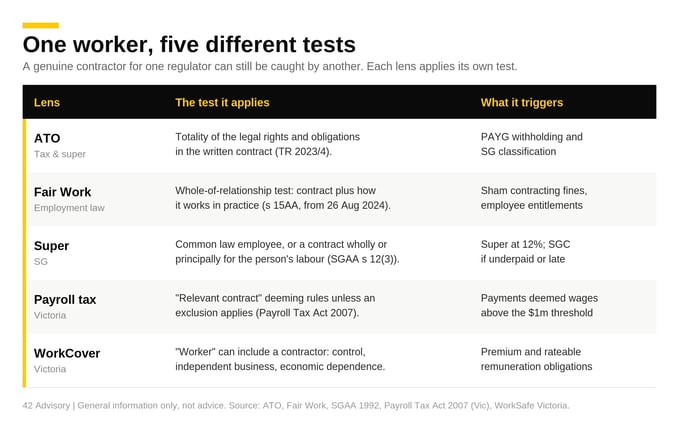
Worker classification in 2026 is no longer an ABN question. A genuine contractor for ATO purposes can still trigger superannuation, payroll tax, WorkCover, PSI and Fair Work obligations, each under a different test. Review the written contract and the real working arrangement before you engage, and document your conclusion.
The line between a contractor and an employee is one of the most consequential calls a Melbourne business owner makes. Get it wrong and the exposure compounds across regulators: superannuation guarantee charges, PAYG withholding penalties, payroll tax assessments, WorkCover premium adjustments, Fair Work sham contracting fines, and back-payment of employee entitlements.
Since the High Court decisions in CFMMEU v Personnel Contracting [2022] HCA 1 and ZG Operations v Jamsek [2022] HCA 2, and the ATO's Taxation Ruling TR 2023/4, the approach to classification has shifted toward the contract. But the contract test only answers part of the question. This guide sets out the full 2026 picture: the ATO framework, the separate Fair Work test, super and Payday Super, PSI, payroll tax, WorkCover, TPAR, the proposed trust changes, and a practical review process you can apply.
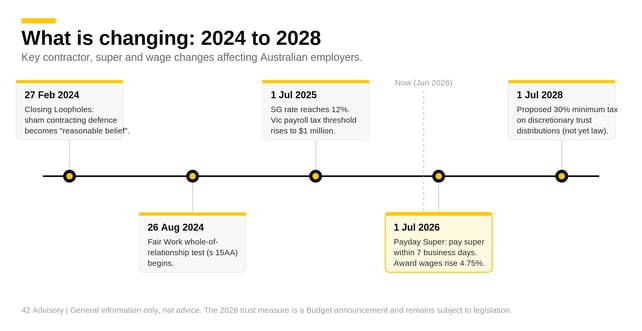
Source: Australian Taxation Office, Super guarantee percentage.
How Does the ATO Decide if a Worker Is an Employee or Contractor?
For ATO purposes, the starting point is the written contract and the legal rights and obligations it creates, not labels, ABNs or invoices. No single factor decides the outcome. This is the tax and super test only. Fair Work, payroll tax and WorkCover apply their own, sometimes broader, tests.
Following the 2022 High Court decisions and reflected in TR 2023/4, the primary inquiry is the totality of the legal rights and obligations established by the contract. Where the contract is comprehensive, in writing, and not a sham or varied by later conduct, its terms usually govern the relationship.
Several indicators remain relevant when reading that contract. They are not a rigid checklist, but together they show whether the substance is employment or genuine contracting.
| Indicator | Points to employee | Points to contractor |
|---|---|---|
| Control | Business directs when, where and how work is done | Worker controls method and timing |
| Financial risk | Paid regardless of business performance | Bears risk of profit or loss, invests in the business |
| Delegation | Cannot delegate or subcontract | Free to subcontract or delegate |
| Tools | Business supplies tools and plant | Worker owns or leases their own equipment |
| Exclusivity | Works exclusively for the business | Free to work for multiple clients |
| Payment | Regular wage, salary or commission | Invoices for a result or milestone |
TR 2023/4 sets no fixed hierarchy among these. Control matters, but it is not automatically weighted above the rest. If the contract is incomplete, oral, or varied by conduct, the actual working arrangement can also be examined. Our small business accounting team runs worker classification reviews for Melbourne SMEs.
ATO Test vs Fair Work Test: Why They Are Not the Same
From 26 August 2024, most constitutionally covered businesses apply a whole-of-relationship test under section 15AA of the Fair Work Act 2009. It weighs the contract and how the relationship works in practice. So a worker can be a contractor for the ATO yet an employee for Fair Work.
This is the gap that catches business owners. "The ATO says contractor, so we are safe" is one of the most expensive sentences in Australian business. The two regimes ask different questions.
Section 15AA, inserted by the Closing Loopholes reforms, restores a focus on the "real substance, practical reality and true nature" of the relationship for Fair Work purposes. The Fair Work Ombudsman applies the whole-of-relationship test for businesses covered by the national system. A narrower start-of-relationship test still applies in some situations, including certain state-referred arrangements and work performed before 26 August 2024. Eligible contractors earning above the contractor high income threshold can also opt out of the employee definition.
The practical takeaway: clear the ATO test and the Fair Work test separately. A defensible position under one is not a defence under the other.
What Are the Penalties for Sham Contracting in Australia?
Sham contracting is prohibited under the Fair Work Act 2009. Maximum civil penalties per contravention are $19,800 for an individual, $99,000 for a small business, and the greater of $495,000 or three times the underpayment for a larger business. Higher exposure applies to serious contraventions.
Under sections 357 to 359 of the Fair Work Act 2009, it is unlawful to misrepresent employment as contracting, or to dismiss an employee in order to re-engage them as a contractor.
| Category | Maximum penalty per contravention |
|---|---|
| Individual | $19,800 |
| Small business (fewer than 15 employees) | $99,000 |
| Larger business (15+ employees) | Greater of $495,000 or three times the underpayment |
Since the Closing Loopholes amendments (effective 27 February 2024), the defence turns on whether the employer reasonably believed the worker was a genuine contractor. This replaced the easier "not reckless" standard, so the bar is higher.
In practice, a reasonable belief means you can show you actually assessed the arrangement before treating the worker as a contractor. Keep evidence that you reviewed:
- the written contract and its terms;
- how the work is actually performed, including control and delegation;
- the payment structure, tools, insurance and commercial risk;
- any professional advice you obtained on the classification.
Beyond Fair Work, misclassification also brings PAYG withholding penalties, the superannuation guarantee charge, and liability for unpaid entitlements such as leave, notice and redundancy.
When Must You Pay Superannuation for a Contractor?
You must pay super for a contractor who is an employee at common law, or whose contract is wholly or principally for their personal labour under section 12(3) of the SGAA. An ABN does not remove this. The SG rate is 12% from 1 July 2025, and unpaid amounts attract the super guarantee charge.
The Superannuation Guarantee (Administration) Act 1992 defines "employee" both at common law and through an extended definition. Under section 12(3), a person working under a contract that is wholly or principally for their personal labour is treated as an employee for SG, even if they invoice through an ABN.
Miss the correct amount or the deadline and you owe the super guarantee charge (SGC): the shortfall, nominal interest, and an administration fee per employee per quarter. The SGC is not tax-deductible, which makes it materially more expensive than paying on time.
The ATO has consolidated its guidance on who is an "employee" for SG into a draft update, TR 2023/4DC1, which folds in the extended definition (with the former SGR 2005/1 to be withdrawn). It is highly relevant where labour is arranged through intermediaries, service entities or contractor companies. If you use these structures, review whether SG arises despite the commercial wrapper.
A worked figure shows the scale. Misclassify an employee earning $60,000 for four years and the unpaid SG at 12% is roughly $28,800, before interest and admin fees, and before the deduction is lost. Our tax planning service helps quantify and correct exposure of this kind.
What Is Payday Super and How Does It Affect Contractors?
From 1 July 2026, super must reach the employee's fund within 7 business days of payday, replacing quarterly payments. Additional time applies for new starters. Any worker who is an employee for SG, including some contractors, falls inside the new timing, so classification errors surface much faster.
Payday Super, legislated through the Treasury Laws Amendment (Payday Superannuation) Act 2025, takes effect from 1 July 2026. The ATO has released PCG 2026/1, a risk-based compliance approach for the first year (2026 to 2027). The Small Business Superannuation Clearing House closed to new users on 1 October 2025 and is retired from 1 July 2026, so users must move to a SuperStream-compliant payroll solution.
Practical steps before 1 July 2026:
- Review and test payroll systems for 7-day funding.
- Identify contractors who may require SG and bring them into payroll.
- Stop relying on quarterly SG checks; reconcile every pay run.
- Move off the Small Business Superannuation Clearing House.
Our BAS and payroll lodgement service can ready your processes, and our Payday Super employer guide covers the regime in full.
How Do the PSI Rules Differ from Employee Classification?
The personal services income rules sit across Divisions 84 to 87 of the ITAA 1997. They attribute income to the individual and limit deductions for an interposed entity. They do not turn a contractor into an employee. A genuine contractor can still be caught by the PSI rules.
Employee classification and PSI are different tests with different outcomes. If your income is mainly a reward for your personal efforts or skills, it is personal services income. The PSI rules can attribute that income back to you and limit the deductions of your company, trust or partnership. They do not make you an employee; they are a separate income tax regime.
The regime is structured across four divisions: Division 84 defines PSI, Division 85 limits deductions, Division 86 attributes income from a personal services entity, and Division 87 sets the personal services business (PSB) tests. You can self-assess as a PSB, and step outside the attribution rules, if you meet one of the following.
| PSB test | Core requirement | 80% rule applies? |
|---|---|---|
| Results test | Paid to produce a result, supply own tools, liable to fix defects | No |
| Unrelated clients test | PSI from 2+ unrelated clients won through offers to the public | Yes |
| Employment test | Others perform at least 20% (by market value) of principal work | Yes |
| Business premises test | Maintain separate business premises throughout the year | Yes |
The 80% rule is the catch. If 80% or more of your PSI comes from one client and their associates, you generally cannot self-assess under the unrelated clients, employment or business premises tests. You must either pass the results test, which has no 80% requirement, or apply to the ATO for a personal services business determination. For an industry view, see our guide to PSI basics for doctors and our work with tech, SaaS and IT businesses.
Have Questions About Your Worker Arrangements?
Our CPA team reviews contractor classifications, quantifies SG and payroll tax exposure, and strengthens your compliance position.
Contact Us Today →Can Contractor Payments Be Liable for Payroll Tax?
Yes. In Victoria, payments under a "relevant contract" can be deemed wages under the Payroll Tax Act 2007, unless an exclusion applies. From 1 July 2025 the Victorian threshold is $1,000,000, with a 4.85% general rate and a 1.2125% regional rate. Review contractor payments, not only employee wages.
This is the gap most owners miss. A worker can be a genuine contractor for the ATO and Fair Work and still generate payroll tax. The State Revenue Office Victoria treats many contractor payments as deemed wages under the relevant contract provisions in Division 7 of the Act, subject to a set of exclusions (for example, contractors who provide services to the public generally, or work 90 days or fewer in a year).
Businesses near the payroll tax threshold should test contractor spend before assuming they are under the line. The risk is highest for:
- medical and allied health practices engaging practitioners through service entities;
- IT, consulting and professional services firms using subcontractors;
- construction businesses and labour-hire providers.
The relevant contract rules are a particular issue for medical and healthcare practices and for builders and trades. We model payroll tax exposure as part of our business advisory work.
Are Contractors Covered by WorkCover?
Often, yes. A contractor can be a "worker" for WorkCover purposes depending on the arrangement. The test looks at control, whether the contractor runs an independent business, and whether they are economically dependent on the principal. Review WorkCover separately from ATO and Fair Work classification.
Workers' compensation is state-based, and the definition of "worker" varies by jurisdiction. In Victoria the relevant law is the Workplace Injury Rehabilitation and Compensation Act 2013. WorkSafe Victoria confirms that a worker can include a contractor or subcontractor depending on the engagement, particularly where the contractor mainly provides their own labour and is not running a genuine independent business.
Failing to hold the right cover can mean significant penalties and personal liability for injury costs. Review your contractor arrangements against your WorkSafe obligations, and make sure your declared rateable remuneration captures any deemed workers.
What Are Your ABN and TPAR Obligations When Engaging Contractors?
If a contractor does not quote an ABN, you generally withhold 47% from the payment unless an exemption applies. Businesses in relevant industries must lodge a Taxable Payments Annual Report by 28 August each year. Once you are within the rules, there is no minimum dollar threshold per payment.
Always verify a contractor's ABN through ABN Lookup before paying. If no ABN is quoted, no-ABN withholding at 47% generally applies under Division 12 of Schedule 1 to the TAA 1953, unless the supplier provides a completed Statement by a supplier form.
The Taxable Payments Annual Report (TPAR) is a separate obligation. It applies to payments to contractors in building and construction, cleaning, courier and road freight, IT, and security, investigation or surveillance services. For mixed businesses that only partly operate in these areas, the obligation generally arises where payments for relevant services are at least 10% of GST turnover. Once you are within the rules, every relevant contractor payment is reported, with no minimum dollar threshold.
Our bookkeeping team tracks contractor payments, verifies ABNs and prepares your TPAR ahead of the deadline. For more detail, see our guide on who needs to lodge a TPAR.
Could the 2026-27 Budget Trust Changes Affect Contractors?
Possibly. The 2026-27 Federal Budget proposed a 30% minimum tax on discretionary trust distributions from 1 July 2028. It is not a classification rule, but it may affect consultants and contractors who operate through a discretionary trust. The measure is proposed, not law, and remains subject to consultation.
Under the proposed measure, trustees would pay tax to bring the tax on distributed discretionary trust income up to at least 30%. Non-corporate beneficiaries would generally receive non-refundable credits. Carve-outs were announced, including primary production income, certain income of vulnerable minors, and testamentary trusts in existence on 12 May 2026.
The key point for contractors is this: a trust does not, by itself, convert personal labour income into business income. PSI, SG, PAYG withholding, payroll tax, WorkCover and Fair Work all still apply based on the actual arrangement. Because the measure is proposed and subject to legislation, obtain advice through our professional services advisory before restructuring a contractor or service entity.
Contractor or Employee: A Practical Review Process
Use this ten-step process before you engage a worker, and keep the file.
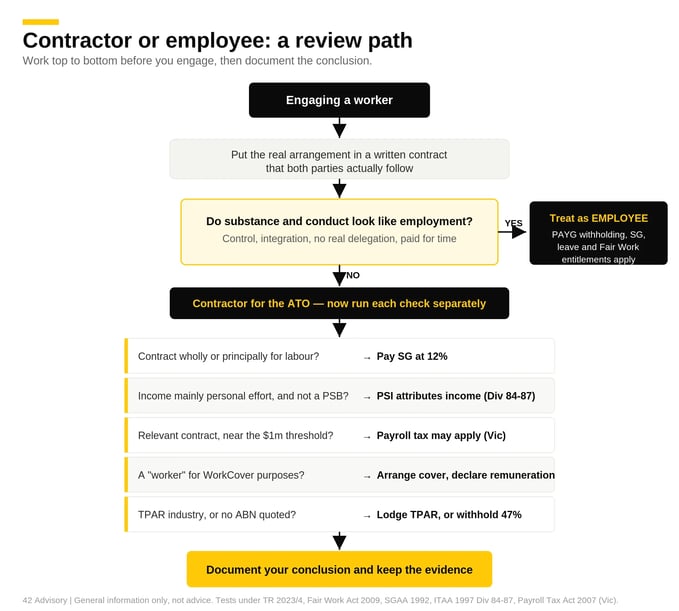
- Identify who is engaged: individual, company, trust, partnership or labour-hire provider.
- Review the written contract: control, delegation, rectification, tools, risk, payment and termination.
- Check how it operates in practice: critical for the Fair Work whole-of-relationship test.
- Assess PAYG withholding: TAA 1953 Schedule 1 section 12-35 and TR 2023/4.
- Assess SG: SGAA section 12, including contractors paid mainly for labour.
- Assess PSI: ITAA 1997 Divisions 84 to 87.
- Assess payroll tax: relevant contract rules, Payroll Tax Act 2007 (Vic).
- Assess WorkCover: do not assume a contractor is excluded.
- Review reporting: TPAR, no-ABN withholding, STP and payroll records.
- Document the conclusion: keep the contract, invoices, insurance, ABN evidence, advice and a classification worksheet.
For help applying this review to your business, see our accounting support for builders and trade businesses.
Contractor Red Flags and Green Flags
A quick screen. The more high-risk indicators present, the more likely the worker is an employee in substance.
| High-risk (looks like employment) | Lower-risk (looks like contracting) |
|---|---|
| Paid hourly or daily | Paid per result or milestone |
| Fixed roster set by the business | Controls how, when and where work is done |
| No real right to delegate | Can genuinely delegate or subcontract |
| Works only for one business | Has multiple clients, advertises to the public |
| Uses the business's tools and systems | Provides own tools, systems and insurance |
| No commercial risk, no defect liability | Bears risk and corrects defects at own cost |
| Part of the internal team in practice | Properly drafted contract that is actually followed |
Four Worked Examples for Business Owners
Example 1: IT developer
Invoices through an ABN, works from home on their own equipment, has three clients, quotes fixed project fees and can delegate. This supports contractor treatment for the ATO, but PSI and SG should still be reviewed.
Example 2: "Contractor" receptionist
Works fixed hours, uses the business premises and systems, cannot delegate, is paid hourly and works only for one clinic. This is high risk and likely requires payroll treatment, including super and entitlements.
Example 3: Medical practitioner
A doctor invoices a clinic through an entity. Even where the doctor is not a common law employee, payroll tax may still apply under the relevant contract rules, depending on how the arrangement is structured.
Example 4: Trades subcontractor
A subcontractor with an ABN, insurance, own tools and several clients may still trigger TPAR reporting. If paid mainly for personal labour, SG must also be reviewed.
What Should a Compliant Contractor Agreement Include?
A well-drafted agreement is the foundation of a defensible classification. Because TR 2023/4 gives primacy to the written contract, it must reflect the true arrangement. Address each of these:
- Scope of work: specific tasks, deliverables and timeline; avoid language implying direction and control.
- Independent contractor statement: confirm the engagement is as a contractor free to work for others.
- ABN and tax details: require a valid ABN; understand your withholding position if none is provided.
- Payment terms: invoice for completed work or milestones; avoid wording that suggests salary or wages.
- Tools and equipment: state who supplies them; if the contractor does, say so.
- Delegation rights: if the contractor can subcontract, record it; this carries significant weight.
- Insurance: require public liability and professional indemnity as appropriate, with proof before work starts.
- Term and termination: define duration and termination; avoid language suggesting permanent employment.
The contract must match reality. A document that says "contractor" but operates like employment protects you under neither the ATO nor the Fair Work framework.
What Should You Do If You Have Misclassified a Worker?
Act early and voluntarily. Quantify the SG shortfall, lodge SG charge statements, correct the arrangement, and assess payroll tax, WorkCover and entitlement exposure. Voluntary disclosure before ATO or regulator contact usually reduces penalties and supports the reasonable belief position going forward.
From 1 July 2026, increased minimum and award wages may raise the cost of correcting a misclassified arrangement, because back-pay is calculated on higher base rates. The national minimum wage rises to $1,004.90 per week, or $26.44 per hour, and award minimums increase by 4.75% from the first full pay period on or after that date, per the Fair Work Commission Annual Wage Review 2026. Reviewing arrangements before the new rates apply limits the exposure.
Summary
Contractor classification in 2026 is no longer a simple ABN-versus-employee question. The key points for Melbourne owners:
- The ATO starts with the written contract under TR 2023/4; substance still matters if the contract is a sham or incomplete.
- Fair Work applies its own whole-of-relationship test from 26 August 2024; clearing the ATO test is not a Fair Work defence.
- Super applies to contractors who are employees or whose contract is principally for labour; Payday Super tightens the timing from 1 July 2026.
- PSI sits across Divisions 84 to 87 of the ITAA 1997 and is separate from classification.
- Payroll tax and WorkCover apply their own tests; contractor payments can be caught by both.
- No ABN means withhold 47% unless an exception applies; TPAR has no per-payment threshold once you are in scope.
Book a Worker Classification Review
Our Chadstone-based CPA team reviews contractor arrangements across ATO, Fair Work, SG, payroll tax and WorkCover, and helps you get the classification right before 1 July 2026.
Schedule a meeting →Disclaimer: The information provided in this article is general in nature and does not constitute specific tax, legal, or financial advice. We recommend seeking professional advice tailored to your individual circumstances. 42 Advisory is a CPA firm and Registered Tax Agent.
Frequently Asked Questions
Can I just label someone a contractor to avoid paying super?
No. Labels do not determine the relationship. The ATO examines the totality of contractual rights and obligations. If the substance is employment, you owe super regardless of the label. The extended definition in SGAA section 12(3) also captures contracts principally for personal labour.
Does the Fair Work definition of employee apply for tax purposes?
No. Section 15AA of the Fair Work Act 2009 requires a whole-of-relationship assessment for Fair Work purposes from 26 August 2024. For tax and super, the TR 2023/4 test applies. A worker can be a contractor for the ATO and an employee for Fair Work.
Can a genuine contractor still create payroll tax?
Yes. In Victoria, payments under a relevant contract can be deemed wages under the Payroll Tax Act 2007, unless an exclusion applies. A worker can be a genuine contractor for ATO and Fair Work purposes and still generate payroll tax for the business engaging them.
What happens if a contractor does not provide an ABN?
If a supplier does not quote an ABN, the payer generally withholds 47% from the payment. The main exception is where the supplier provides a completed Statement by a supplier form explaining why. Always verify ABN details through ABN Lookup before paying.
What is Payday Super and when does it start?
Payday Super starts on 1 July 2026. From that date, super contributions must reach the employee's fund within 7 business days of payday, with additional time for new starters. It replaces the quarterly model, so any SG owed on contractors must be funded much sooner.